The first phase of the new cultural space, located next to the Opera House at the corner of Révay and Dalszínház Streets, was presented on 25 March 2026, on the anniversary of Béla Bartók’s birth, to selected guests and members of the press. The full project is expected to open to visitors in September 2026.
During the development, a two-storey commercial property owned by the Terézváros Municipality, unused for a decade and a half, is being renovated in a UNESCO World Heritage environment, in the immediate vicinity of the Opera House. The OperaSafe Archival Collection is intended to serve cultural, local historical, and tourism functions alike.
At the event, Dr. Szilveszter Ókovács, director general of the Hungarian State Opera spoke about how the institution must argue in many ways to ensure the survival of the genre it represents: “We are also helping our own work: here is a scientific and educational platform through which we can explain what our opera house is like, what it was, and what it is today.”
Máté Vincze, deputy state secretary of the Ministry of Culture and Innovation, praised the OPERA’s efforts to make its past tangible for contemporary audiences: “Preserving memories is only the first step; the real task is to process them, present them, and turn them into an experience for the audience.”
Dávid Rózsa, director general of the National Széchényi Library, which supported the creation of the OperaSafe Archival Collections, drew a parallel between the missions of the two institutions: “This cooperation is not a simple partnership, but a shared mission: to present the richness of Hungarian culture as fully and as vividly as possible.”
Among those attending the event were Éva Marton, a Kossuth Prize-winning opera singer honoured with the Hungarian Order of Saint Stephen and the title Artist of the Nation, and Tamás Soproni, Mayor of Terézváros.
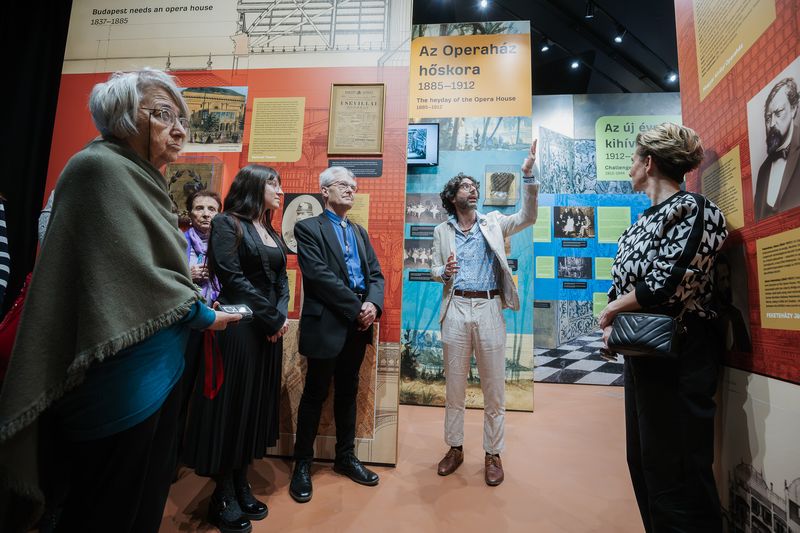
As part of the first phase, a 100-square-meter permanent exhibition presenting the history of the OPERA has been installed, tracing six eras from the founding of the opera department of the predecessor Pesti Magyar Színház in 1838 to the present day. Márton Karczag, head of the OPERA Archives and chief curator of the exhibition, emphasized that just as the Opera House strives not to become a museum in its daily performances, traditional exhibition solutions are no longer sufficient: “We wanted to talk not only about the great artists, but also about those who kept this house alive behind the scenes. In this way, something entirely different from this diverse world may remain with visitors.”
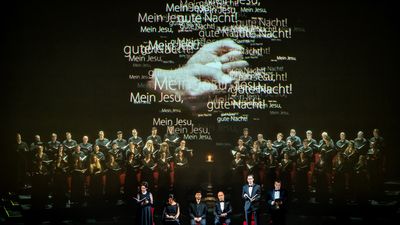
Across twelve richly illustrated, stage-like panels, the exhibition features numerous special items from the collection, including documents related to Ferenc Erkel, Gustav Mahler, and Béla Bartók. The bilingual exhibition also displays personal and decorative objects of legendary OPERA creators, including costume and set designs by Count Miklós Bánffy, a sketchbook by Gusztáv Oláh, and Tivadar Márk’s Mandarin figurine. The exhibition also recalls significant premieres associated with the institution, including Bartók’s Bluebeard’s Castle and The Wooden Prince, as well as works by Zoltán Kodály such as The Spinning Room and Háry János, ballets by Gyula Harangozó and László Seregi, and more recent works such as Valuska, composed by Péter Eötvös based on a novel by László Krasznahorkai. The exhibition also offers insight into the daily life of opera production, with the reverse sides of the stage panels presenting stories, workshop secrets, and objects related to behind-the-scenes staff.
The first phase also includes a roughly 70-square-meter performance space with a capacity of 55 people, designed for panel discussions, chamber concerts, youth programs, and museum education activities. Additionally, a 22-square-meter installation called the Amphitheatre has been created using around 300 auditorium seats preserved from the period before the Opera House renovation between 2017 and 2022. The interior design of the OperaSafe spaces was created by Márton Lengyel.
In the coming months, nearly 100 additional square meters will be developed for tourism, educational-entertainment, and research purposes. As part of this, the spacious basement level will house the OPERA’s sound archive, while also functioning as a podcast studio and providing space for themed escape rooms. The OperaSafe Archival Collection of the Hungarian State Opera is expected to open in its final form, with expanded services, in September 2026 at the start of the new season.
The Archival Collection of the Royal Hungarian Opera House was founded in 1930 by director Miklós Radnai. Its first organizer was Dezső Vidor, secretary of the opera house, who set up the first exhibition in two meeting rooms on the second floor, where it remained on view until the end of World War II. An important milestone in the collection’s history was the exhibition organized in 1984 by theatre historian Géza Staud for the centenary of the institution, displayed in the Opera House’s corridor.
The property housing the OperaSafe Memorial Collection, located at 8 Dalszínház Street in Terézváros, functioned as an opera club from the 1950s until the political transition. It served as a meeting place for opera singers and ballet artists, as well as other figures of the artistic community. From the 1990s, the Belcanto restaurant operated on the site, often providing debut opportunities for young opera singers. After standing empty for fifteen years, the property was made available for lease to the Hungarian State Opera by the Terézváros Municipality following approval of the institution’s operational concept.
Photo by Attila Nagy