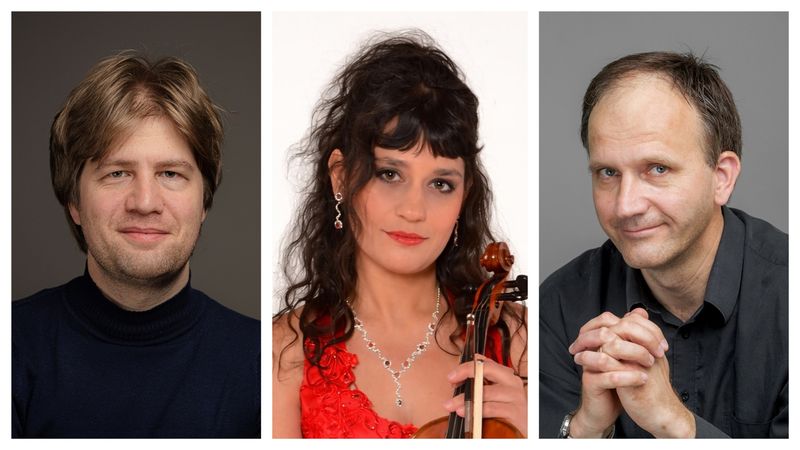
The next event in the Medgyaszay Chamber Evenings series showcases the violin’s rich emotional world akin to the human singing voice, presented by opera répétiteur Balázs Kálvin and the guest artist of the series, violinist Anita Bujtás. At the Opera House concert on 15 January 15 2026, the famous aria from Norma as well as several songs by Balázs Kálvin can be heard performed on the violin, while virtuoso and deeply moving works by Massenet, Franck, Elgar, and Brahms also promise a memorable evening.
The spiritual kinship between the violin and the human voice, the concept of the “singing” violin, plays a central role in the joint concert of Anita Bujtás and Balázs Kálvin. In the Medgyaszay Hall of the Opera House, the two artists illuminate the connection between these two forms of expression through works such as the violin transcription of the famous Casta Diva aria from Bellini’s Norma, which offers an excellent opportunity to convey feminine sensitivity and subtle emotional nuance. From the songs of Balázs Kálvin, who has been active as a composer since childhood, three pieces from the cycle Messages of the Heart will be heard in violin arrangements, along with Ave Maria, inspired by Chopin’s Étude in C major. The evening also provides an opportunity to express both the lyricism and virtuosity of the violin through popular, deeply affecting works such as the Meditation from Massenet’s opera Thaïs, Franck’s Sonata in A major, and Brahms’s Scherzo from F-A-E Sonata.
At this personal-toned concert, two works by Anita Bujtás’s father, violinist and composer József Bujtás, one of the founders of the Society of Creative Musicians, is also to be performed. These include Poema Fantasia, based on Scriabin motifs, whose performance a year earlier marked the beginning of the intensive professional collaboration between Anita Bujtás and Balázs Kálvin, as well as the world premiere of Duo for Violin and Cello, featuring Dr. László Pólus, principal cellist of the Hungarian State Opera Orchestra. The musical pieces are connected by short conversations in which music historian Dániel Mona interviews the performers.
Please note that the interviews are conducted in Hungarian with no subtitles provided.
Photos by Attila Nagy / János Kummer