
The Little Sweep
MVM Piccolo Programme
Details
In Brief
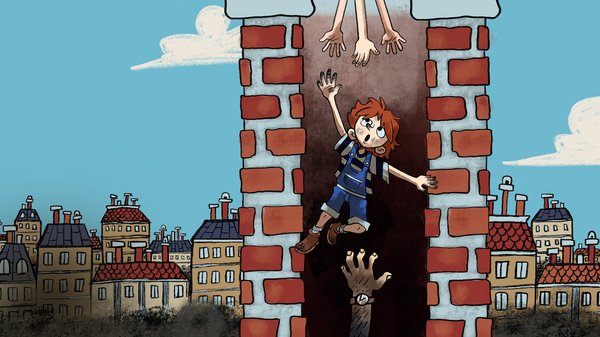
According to artistic director András Almási-Tóth, Benjamin Britten's opera about a child trapped in a chimney and tried to be rescued by his little friends "is a classic liberation opera translated into a children's adventure film.” The new production of British composer's work was first presented in the 2024/25 Anglophone Season of the Hungarian State Opera as an addition the wide repertoire aimed at young audiences to present a new opportunity to introduce the genre to younger generations. The concept by the renowned puppeteer and musician János Novák was staged by Attila Toronykőy, an expert "speaking the language of young audiences", who has already directed numerous children's and youth productions.
Parental guidance
Events
Premiere: April 26, 2025
Media
Opera guide
Introduction
The English composer Benjamin Britten (1913–1976) began his career as a child prodigy, composing as early as the age of five. He initially wrote film music but achieved international fame primarily through his operas. The children’s opera The Little Sweep was premiered in 1949 at the Jubilee Hall in Aldeburgh. The work is an opera about innocence that is mocked and deceived. The fate of the boy, forced into cruel labour, avoids turning tragic almost solely thanks to children’s solidarity. The triumph of naive, action-driven goodwill – standing in opposition to the absurdity of the adult world – sharply exposes the unsustainability of the existing situation. Britten’s work also acquires a social dimension: the natural musical aristocratism of the children’s world stands in firm contrast to the hypocritical, false decorativeness of adult pretension.
The conductor’s thoughts
Anyone even slightly familiar with Britten would not assume that he composed easy musical material; yet, surprisingly, The Little Sweep contains almost hit-like numbers. It is catchy music that is also easy for children to learn. The parts written for adults, however, are considerably more demanding from both harmonic and rhythmic perspectives. An interesting challenge for the children is that there is an entire act in which they do not sing but speak; and although we are not a spoken theatre company, it is important that they try themselves in this area as well. At the same time, there is also a great deal of singing to be done – few children’s works give the young performers a truly greater role than the adults. One of the distinctive features of the production is that the instrumental ensemble performing the small-scale score (a string quartet, percussion, timpani, and a piano four hands) is positioned on stage. In this respect as well, the performance can become visually engaging and instructive for both the performers and the audience.
As for Britten’s music, the composer wrote the work with incredible expressiveness. Even if one does not see the stage action and only listens, it is often possible to guess what is happening on stage. A single heartbeat, the tension in Miss Bagott’s steps as she notices that everything is covered in soot – expressed through rising dynamics, with chords aligning with her footsteps – or the arrival of the cart signalled by the timpani all demonstrate the close interweaving of plot and music (or orchestra). It is thus evident that the music and the stage action form a perfect unity, which sets this work apart from other children’s pieces, while at the same time fitting seamlessly into the line of Britten’s other operas. The composer created this children’s work with the same exceptionally high standard as all of his other operas.
Nikolett Hajzer