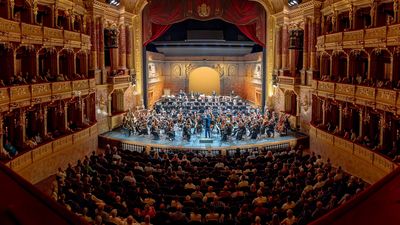
Following its great success with audiences and critics alike at the Erkel Theatre, Arnold Schönberg’s oratorio Gurre-Lieder is presented at the Opera House on 24 May 2026. The rarely performed masterpiece, which requires more than three hundred performers, is conducted by Gergely Dubóczky with principal roles performed by István Kovácsházi, Tünde Szabóki, Atala Schöck, Zsolt Haja, Gergely Ujvári, and Dénes Gulyás.
Every performance of Arnold Schönberg’s monumental Gurre-Lieder is an exceptional occasion. This is justified not only by the immense orchestral and choral forces required and their elemental power, or by the work’s embodiment of the culmination of post-Romantic music, but also by the profound communal experience reported by many who took part in the OPERA’s 2025 production at the Erkel Theatre. Following its sold-out performance and great acclaim from both audiences and critics, the production can now also be experienced within the historic walls of the Opera House by all those wishing once again to feel the extraordinary impact of Schönberg’s work.
The Hungarian State Opera Orchestra and Chorus are conducted by Gergely Dubóczky, one of the most versatile and innovative Hungarian conductors of his generation. The artistic director of the Szeged Symphony Orchestra has previously worked alongside notable figures including Zoltán Kocsis, Iván Fischer, Ádám Fischer, and Péter Eötvös. As an opera conductor, he has conducted works by Mozart, Bartók, Britten, Purcell, Johann Strauss II, and contemporary composers. He made his debut at the Hungarian State Opera with the production Artaban.
The solo roles are once again be performed by outstanding artists from the OPERA’s highly acclaimed 2025 production, including several of the company’s leading Wagner singers such as István Kovácsházi (Waldemar), Tünde Szabóki (Tove), Atala Schöck the (Wood dove), Zsolt Haja (Peasant), Gergely Ujvári (Klaus the Jester), and Dénes Gulyás (Narrator). As before, the monumental production is accompanied by projections created by Zsombor Czeglédi.
Gurre-Lieder occupies a special place within Schönberg’s oeuvre. Although the composer’s name is often associated with 20th-century modernism and atonality, this grand-scale work still belongs to the world of late Romanticism, simultaneously revealing the musical influence of Richard Wagner, Richard Strauss, and Gustav Mahler.
The story is based on the poem cycle Gurresange by the Danish writer Jens Peter Jacobsen. At its centre lies the love between King Waldemar and Tove: forbidden passion, jealousy, murder, grief, and a curse merge into a medieval legend. The first part of the work still unfolds as a love idyll, with the songs of Waldemar and Tove expressing fleeting moments of desire and happiness through images of nature. However, the Wood dove’s deeply moving song announces Tove’s death, and in his despair Waldemar turns against God. As punishment, after his death he is condemned to ride night after night across the landscape at the head of his dead soldiers, until, with the coming of dawn, the ghostly vision dissolves into a vision of nature itself before the monumental choral finale greeting the rising sun.
Photo by Zsófi Raffay