Dear Visitor,
The Hungarian Holy Crown, together with the surviving royal coronation regalia, is among the most treasured relics of Hungarian history.
The Kingdom of Hungary was founded on Christmas Day in the year 1000, or on 1 January 1001, by Prince Stephen (born Vajk) of the House of Árpád. His coronation and the Christian character of the new Hungarian state were supported by Pope Sylvester II. The upper, so-called Latin section of the Holy Crown may even have originated from the papal court. The lower, so-called Greek or Byzantine circlet was probably made during the same century as the upper section, sometime between 1000 and 1100. These two separate goldsmiths’ works were most likely joined together at the end of the eleventh century, and from that point onward Hungarian kings were crowned with this assembled crown. The cross atop the crown became bent in the seventeenth century when the iron chest protecting the regalia was forcibly opened. Thereafter, no one dared restore it to its original position. Over the course of a thousand years, the crown was taken or stolen abroad on eleven occasions, buried together with its chest four times, and once even lost altogether. It is a remarkable stroke of fortune – perhaps even a special act of divine providence – that it ultimately survived. The Holy Crown was last used to crown a King of Hungary in 1916, when Charles IV ascended the throne. The organisation of the coronation ceremony in Buda Castle was entrusted to Count Miklós Bánffy, then intendant of the Hungarian Royal Opera, which had opened only a few decades earlier.
A Hungarian king was also present at the inauguration of the palace on Sugár Avenue (today Andrássy Avenue), the masterpiece of architect Miklós Ybl. Emperor-King Franz Joseph I personally inaugurated the institution, Hungary’s first, and to this day only opera house. The building’s design paid extraordinary attention to royal protocol. A dedicated royal wing was created, including a carriage entrance, waiting room, royal staircase, gallery, reception room with terrace and private facilities, an incognito box with an antechamber, and, most importantly, the ten-seat Royal Box located at the centre of the auditorium and connected to a large royal salon decorated with red silk wall coverings. (You are reading this text in that very salon.)
As the 1025th anniversary of the Kingdom of Hungary approached, the Hungarian Royal Opera (known since the spring of 1945 as the Hungarian State Opera), as a national institution and the largest theatre in Hungary, dedicated one of its resources each year since 2020 to the legacy of Saint Stephen. We have presented Beethoven’s incidental music King Stephen, while its overture has been performed on numerous occasions as a concert work. The entire OPERA Chorus, the largest chorus in Hungary has performed Zoltán Kodály’s mixed-chorus setting Song to King Saint Stephen, composed in 1938 for the 900th anniversary of the saint’s death. We commissioned a symphonic orchestration of Stephen, the King, the celebrated work by Levente Szörényi and János Bródy, and kept it in our repertoire for several seasons; indeed, we welcomed the New Year with this production. A student version of the work, performed by the OPERA Children’s Chorus, has also been staged and remains in repertoire at the Eiffel Art Studios, the institution’s second major venue. We have furthermore completed the recording of Ferenc Erkel’s final opera, King Stephen, the first one based on a critical edition of the score. The work was originally intended for the opening of the present Opera House in 1884.
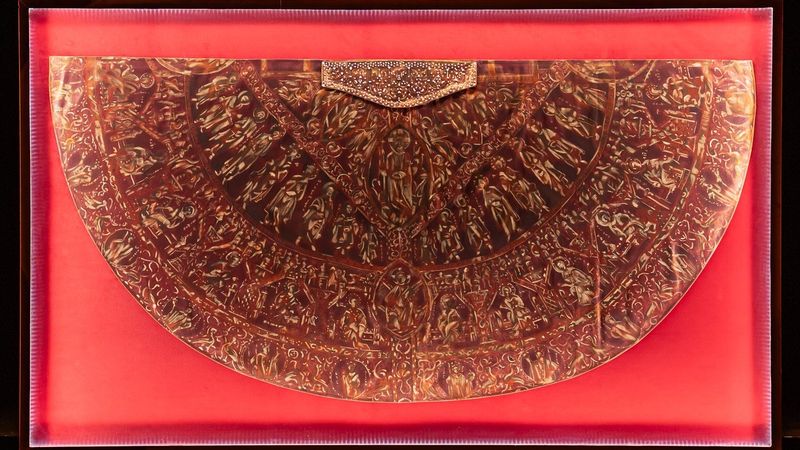
In the workshops of the OPERA's Eiffel Art Studios, the largest, most active, and highest-quality production facilities in Hungary, our artists created replica versions of the thousand-year-old Coronation Mantle. These were intended as gifts, enabling as many people as possible to see and discuss this exceptional object, since the original cannot be moved. The first facsimile was presented to the Hungarian Parliament Building at New Year 2026, where the remaining coronation regalia are displayed beneath the central dome. A near-pristine version was given to the Hungarian National Museum, allowing visitors to compare its appearance with that of the original and appreciate the changes brought about by a millennium of history. Two Hungarian towns also deserved to receive replicas. One is Veszprém, where the mantle was created in 1031 and which is associated with Queen Gisela. The other is Székesfehérvár, the ancient coronation city, whose civic leadership has made outstanding efforts over the past fifteen years to preserve the memory of the Árpád Dynasty and has begun assembling replicas of the coronation regalia. These presentations were scheduled strategically, providing opportunities to address the nation repeatedly and to remind Hungarians of the immeasurable significance of the foundation of the Kingdom of Hungary, without which none of us would exist today.
We at the Hungarian State Opera have assembled in these display panels those royal props that appear in our productions, including László Hunyadi and Stephen, the King, and which serve as high-quality artistic replicas of our historical relics. Let them stand here rather than hidden away in storage. Let them testify to the artistic standards of the OPERA as a theatre, remind visitors of the institution’s royal origins 142 years ago, strengthen the patriotic commitment of Hungarian visitors, and offer our international visitors an insight into the 1025-year continuity of Hungarian history.
The Coronation Mantle was indeed created in 1031, a scientifically established fact. It was originally intended as a liturgical vestment, and Queen Gisela herself is believed to have participated in its embroidery. Prince Emeric, the royal couple’s deceased son, is also depicted upon it. Only later was it converted into a coronation mantle. Among the smaller coronation regalia, the crystal sphere of the sceptre is the oldest component. It was made in tenth-century Egypt, while its gilded hazelwood shaft dates from the eleventh century. Saint Stephen himself may have used this sceptre. The coronation orb is made of gilded silver and is hollow inside. It was created during the reign of the Angevin kings of Hungary in the early fourteenth century. Saint Stephen certainly possessed an orb, but it must have been a different one; the present example later became part of the coronation ensemble. The coronation sword was most likely forged in Northern Italy in the mid-fifteenth century. This steel weapon is therefore the youngest item among the regalia, despite being nearly six hundred years old. Saint Stephen naturally used a different sword, which is preserved in Prague today. (The pectoral cross displayed here, together with its matching ring and large pendant on a chain, was created by costume designer Rita Velich for our production of Stephen, the King, drawing inspiration from medieval models.)
Finally, we may ask: what is the value of the Holy Crown? A monetary answer is possible. In 1464, when Hungary’s greatest king, Matthias Hunyadi, succeeded after five years of negotiations in repurchasing the stolen crown from its “captivity” in Austria, the 80,000 gold florins demanded by the Habsburgs represented roughly one-third of the revenues of the medieval Hungarian state. Measured against today’s national budget, this symbolic value translated into modern currency would amount to approximately 20 trillion Hungarian forints (around 50 billion euros). An inconceivable sum. Even 550 years ago, a special tax had to be levied to raise it. Yet numbers fail to capture the true significance of the Holy Crown. As a relic, an idea, and a national myth, it means even more to the Hungarian people.
Let us therefore use the word "priceless" without hesitation.
On 4 June 2026, the Day of Hungarian National Unity
dr. Szilveszter Ókovács
general director
Hungarian State Opera
Photo by Valter Berecz