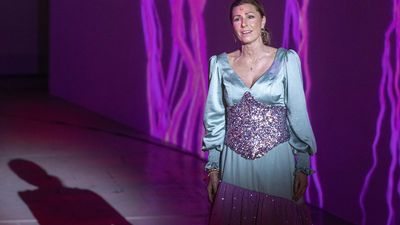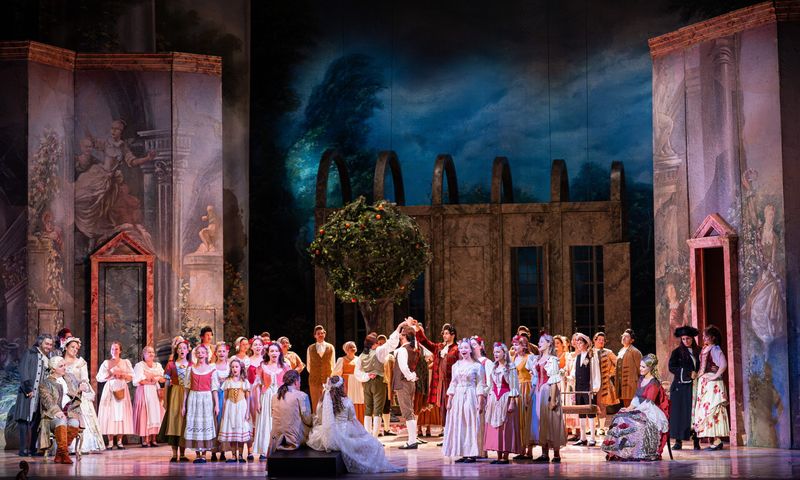
Liszt Ferenc Prize-winning soprano Emőke Baráth makes her Budapest debut as Susanna in one of Mozart’s most popular comic operas, performing alongside internationally acclaimed Hungarian artists including Polina Pasztircsák, Gyula Orendt, Krisztián Cser, and Miklós Sebestyén. The ensembles of the Hungarian State Opera are conducted by Gábor Káli. Le nozze di Figaro is presented between 20 September and 11 October, marking the final performances of Judit Galgóczy’s production at the Opera House.
One of Mozart’s best-known masterpieces explores the relationships between master and servant, man and woman, power and vulnerability through witty situations and subtle social criticism. Mozart and his librettist, Lorenzo Da Ponte, softened the political edge of Beaumarchais’s original story, while capturing human emotions with exceptional precision. The work is performed at the Opera House for the first time under the baton of Gábor Káli, a conductor regularly engaged by leading opera houses and concert halls across Europe.
In the first opera production of the Hungarian State Opera’s 143rd season, Emőke Baráth makes her debut as Susanna. Figaro’s resourceful fiancée simultaneously fends off the unwanted advances of Count Almaviva and helps her mistress, the Countess Rosina, win back her husband. The internationally acclaimed soprano, who is equally at home in Mozart repertoire, returns to a staged production at the Opera House three years after the premiere of Idomeneo; she has previously sung Susanna at Theater an der Wien.
As Count Almaviva, Gyula Orendt, a soloist of the Berlin State Opera, returns to Budapest; he will also perform the role in Berlin in October. Polina Pasztircsák, twice named Kammersängerin of the Hungarian State Opera, takes on the role of the Countess at the Opera House again after ten years. Figaro is portrayed by Krisztián Cser, a Kammersänger who has regularly performed the role to great acclaim over the past decade.
In three performances of the series, Count Almaviva is portrayed by Csaba Szegedi, who returns to one of the defining roles of his early career after eight years. Anija Lombard makes her debut as Susanna. A former student of the Éva Marton International Opera Studio, she makes her debut in her first leading role at the Opera House.
Bartolo is performed by Miklós Sebestyén, who has enjoyed a significant international career and also sang the role at the Zurich Opera House earlier this year. Laura Topolánszky returns as Cherubino, while Erika Gál (Marcellina), Botond Pál (Don Curzio), Artúr Szeleczki (Basilio), and László Szvétek (Antonio) reprise roles they have performed previously. Two young artists make their Opera House debuts as Barbarina: Renáta Gebe-Fügi, from the Hungarian Opera of Cluj-Napoca, and Fanni Faluvégi, from the opera company of the Csokonai National Theatre in Debrecen.
Judit Galgóczy’s production, which has reached 190 performances, is seen for the final time on the stage of the Hungarian State Opera House. According to current plans, audiences can subsequently be able to see the production at the Eiffel Art Studios and on tour. The production features the Hungarian State Opera Orchestra and Chorus (chorus director: Gábor Csiki), as well as students of the Hungarian Dance University. Le nozze di Figaro is performed on 20, 22, 24, 27 and 30 September, and on 3, 6 and 11 October 2026.
Photo by Valter Berecz