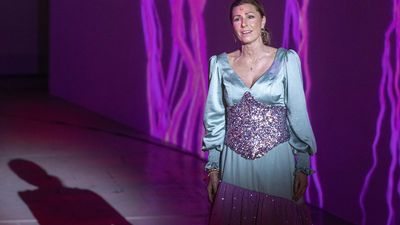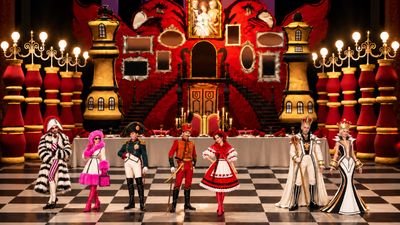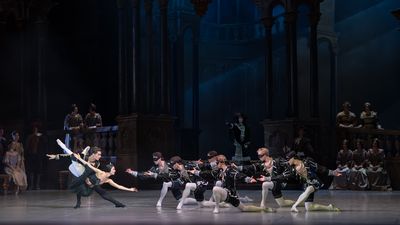
Love, jealousy, political terror and murder – Puccini’s Tosca, one of the composer’s most gripping operas, takes on a special, highly detailed sonic dimension at the Hungarian State Opera as part of the Opera IC Audiophile series. Zsuzsanna Ádám takes on the title role on 15, 25 and 28 October, while Csilla Boros performs it on 10 and 18 November, joined by leading soloists and under the baton of two outstanding conductors, István Dénes and Cornelius Meister.
Few works are better suited to introducing audiences to the world of opera than Tosca. Puccini’s work unfolds at an almost cinematic pace, with political persecution, jealousy, torture, murder and execution following one another in quick succession. The tension is heightened by bells, cannon fire, singing heard from a distance and the monumental Te Deum that concludes the first act. At the heart of the story is the fatal clash between three powerful personalities: Floria Tosca, the celebrated singer who is prepared to do anything for the man she loves; Mario Cavaradossi, a painter who risks his life by helping an escaped political prisoner in his stand against oppression; and Scarpia, Rome’s feared police chief, who uses both his power and his desire for Tosca as weapons against them. Within a single day, the fate of all three is sealed.
In the Opera IC Audiophile series, the musical and psychological details of this drama are brought unusually close to the audience. The name IC is short for iron curtain: the 170-square-metre steel surface closing off the stage acts as an acoustic reflector, enhancing the acoustics of the Opera House, while also serving as a projection screen for a bespoke video installation and surtitles. The orchestra performs in the pit, while the solo singers perform directly at the front of the stage and the chorus joins in from various points throughout the building. Positioned between a concert performance and a fully staged opera, this format places the focus above all on Puccini’s music and the singers’ performances, while making the opera experience more accessible through reduced ticket prices.
In the October performances, Zsuzsanna Ádám takes on the role of Tosca, while in November the celebrated diva is portrayed by Csilla Boross, who is equally at home in major dramatic roles in Hungary and abroad. Boldizsár László and Adorján Pataki sing Cavaradossi, while Károly Szemerédy and Mihály Kálmándy appear as the ruthless Scarpia. The October performances are conducted by István Dénes, a Liszt Prize-winning eternal member of the Hungarian State Opera, while the November performances are conducted by Cornelius Meister, general music director of the Stuttgart State Orchestra.
Introduced last season, the Opera IC Audiophile series continues during the Season of Eastern Tales with Tosca – which returns for further performances in January with Eszter Sümegi in the title role – as well as Don Giovanni, Rigoletto, Bluebeard’s Castle, and Parsifal.