
Fidelio
Details
In Brief
Amidst the many stories of strong and heroic men, a work where true strength and resolution are embodied by a woman – even if she must disguise herself as a man to achieve her goal – always raises fascinating questions. Ludwig van Beethoven’s only opera brings together multiple traditions: it incorporates the Singspiel (a musical drama with spoken dialogue), an almost fairy-tale-like happy ending, the legacy of Viennese classicism, and a foreshadowing of Romantic grandeur. At the same time, it stands as one of the most iconic examples of rescue opera, in which a wife, Leonore – disguised as Fidelio – fights to save her unjustly imprisoned husband, Florestan.
The OPERA follows a long-standing tradition by collaborating with major international opera houses or adopting productions to offer the Budapest audience a taste of European performances. Following last year’s Don Giovanni from Berlin, this time it presents a production from London’s Royal Ballet and Opera, directed by Tobias Kratzer, the director of the Hamburg Opera from the 2025/26 season. His staging masterfully blends traditional and modern elements in an exciting way, under the baton of Péter Halász. The production was a resounding success in London, making it a great privilege that it will be the Budapest audience to experience it first internationally outside the UK.
Based on the production by Royal Opera, Covent Garden, London. First performed at the Royal Opera House, Covent Garden on 1 March 2020.
Parental guidance
Events
Premiere: April 18, 2026
Synopsis
There is no other opera quite like Beethoven’s Fidelio, which is divided into two such distinctly different parts. While the first act is a historical melodrama about freedom and love in the aftermath of revolutionary times, the second is a political essay on the responsibility of the individual in the face of a silent majority: a musical plea for active empathy.
Act I – Liberté, Égalité, Fraternité
A prison courtyard
Marzelline, the daughter of Rocco, the prison warden, desperately tries to fend off the advances of the young gatekeeper Jaquino (“Jetzt, Schätzchen, jetzt sind wir allein” / “We're alone now, sweetheart,”). The two young people were once a couple, but the girl is now interested only in Fidelio, the new prison guard, and secretly dreams of a shared future with him (“O wär’ ich schon mit dir vereint” / “Oh, if only we were united”). Marzelline does not suspect that Fidelio is in fact a noblewoman called Leonora, who has disguised herself as a man in order to find her missing husband, Florestan, in the prison. Leonora, Marzelline, Jaquino, and Rocco each imagine their futures differently (“Mir ist so wunderbar” / “Such a wonderful feeling”).
Rocco is also unaware of Fidelio’s true identity and hopes that his new employee will become his future son-in-law, so he gives him a lesson in practicality (“Hat man nicht auch Gold beineben” / “Unless we have gold to live on”). Marzelline tries to grow closer to Fidelio, who in turn asks Rocco for a favour: he wants to descend into the dungeon where Florestan is presumably being held (“Gut, Söhnchen, gut, hab immer Mut” / “All right, lad, go ahead”).
The sound of a march announces the arrival of Pizarro, the prison governor. Once a close friend of Florestan, he has become his bitter enemy due to political circumstances, and it was he who secretly ordered Florestan’s imprisonment. Before the minister’s impending visit, he resolves to have Florestan killed before his whereabouts are discovered (“Ha! Welch ein Augenblick!” / “The moment has come!”). Promising a generous reward, he orders Rocco to prepare the illegal execution. Rocco is torn between compassion and duty (“Jetzt, Alter, jetzt hat es Eile!” / “Now, old man, hurry up!”).
Pizarro’s plan also drives Leonora to action. In terror, she recalls her love for Florestan and her determination (“Abscheulicher! Wo eilst du hin?” / “Where are you rushing to, you scoundrel?”). First, appealing to human compassion, she persuades Rocco to grant the prisoners a brief happy moment in the fresh air (“O welche Lust, in freier Luft” / “What joy! To breathe freely”). Although outraged, Pizarro also allows Rocco to take Fidelio along as his assistant into the dungeon, where Florestan languishes in chains. Leonora and Rocco descend into the prison’s secret chamber.
Act II – “Wer du auch seist, ich will dich retten” (“Whoever you are, I'll save you”)
A dungeon
Florestan is surrounded by darkness and silence, with no hope of help. His faith in God and in humanity, is sustained only by the thought of Leonora (“Gott! Welch Dunkel hier!” / “God! What darkness here!”).
Rocco and Fidelio uncover a grave. Leonora cannot believe that the dishevelled prisoner is her husband, yet she resolves to save him even if he is not Florestan (“Nur hurtig fort, nur frisch gegraben” / “Be quick, let's dig fast”). Appealing once more to his compassion, she persuades Rocco to give the prisoner water and bread. Florestan, who does not recognize his wife either, is moved by the stranger’s kindness (“Euch werde Lohn in bessern Welten” / “You will be rewarded in a better world”).
Pizarro appears, and events accelerate: the prison governor intends to carry out the execution himself (“Er sterbe!” / “He shall die!”). Before he can kill Florestan, however, Fidelio stands between them and reveals her true identity with the cry: “Kill his wife first!” The turmoil is interrupted by the sound of a trumpet, signalling the arrival of the minister who brings clemency. Yet danger is not entirely over. Leonora and Florestan finally recognize each other (“O namenlose Freude!” / “Oh inexplicable joy!”).
Only when the people raise their voices does the prison transform into an open space. The minister grants Florestan mercy in the name of the majority. Don Pizarro is disarmed, and Marzelline, setting aside her own feelings, joins in the general liberation. The euphoria surrounding Leonora’s successful rescue knows no bounds (“Heil sei dem Tag” / “Hail to the day”).
Tobias Kratzer
Media
Reviews
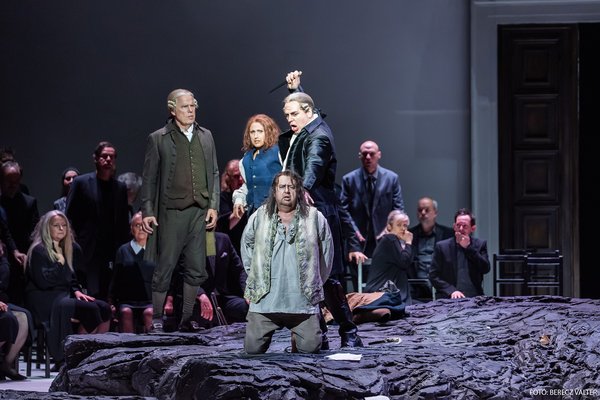
"The first act’s physical setting, designed by Kratzer, Rainer Sellmaier (set and costumes) and Michael Bauer (lighting design), perfectly resembled a painting of that dark time in French history. (...) The second act, titled 'Whoever you are, I’ll save you,' took an abrupt stylistic turn, putting the characters and the larger publicum into a blend of 1789 and 2026. While Leonora was fighting her enemies on a hill of dirt, wearing layers of clothing to hide her gender, a huge chorus of singers and actors surrounded them. They were dressed in chic modern black attire while sitting in a giant white public space, watching the protagonists’ heated discussion. A live video camera was covertly positioned to catch the public’s reactions. Their faces loomed ominously on an oversized screen on the back wall, and their expressions moved slowly, from boredom to total engagement in the drama unfolding before their eyes."
Alexandra Ivanoff, Papageno
"At the Hungarian State Opera, Beethoven’s Fidelio emerges as an especially compelling and humane work, and Tobias Kratzer’s production gives it precisely the mixture of theatrical intelligence and emotional immediacy it deserves. As one of the great rescue operas in the repertory, Fidelio can so easily become a monument of noble intention without sufficient dramatic life; here, however, it feels vivid, urgent, and deeply moving. (...) What makes this production so effective is that it never treats Beethoven’s only opera as a museum piece. Instead, it places the story in a living theatrical frame that allows the tension between oppression and rescue to unfold with clarity and force. The result is a production that feels both classic and contemporary, emotionally direct yet intellectually alert."
Nadejda Kommendantova, European News Agency
“The production’s one notable feature is that the director sets the performance during the Reign of Terror of the French Revolution, and quite rightly so, since the original, real-life story, which Jean-Nicolas Bouilly wrote for Pierre Gaveaux, indeed takes place in this period. (…) In the first part, we see a highly detailed, realistic staging. Even the overture is staged: starving crowds break in from outside the prison and throw themselves upon the prisoners’ rations of bread, before being driven out by soldiers. (…) From this realistic staging, the production moves in the second part towards a more abstract, more philosophical mode of presentation.”
Máté Mesterházi, Új Zenei Újság
Opera guide
Introduction
Due to the work’s at times particularly powerful, almost liturgical-sacral tone (from which even the love duet of Florestan and Leonora is no exception), Wilhelm Furtwängler considered Fidelio not an opera at all, but rather a mass. Others argue that it is not a true opera because it is in fact a Singspiel, interspersed with spoken dialogue, and thus an operatic continuum cannot truly come into being. A more recent view holds that Beethoven actually wrote a symphony in operatic form, since the best parts (for example, the prisoners’ chorus) are symphonically composed. Georges Duhamel formulates this cluster of problems very precisely when he describes Fidelio as presenting “a genius struggling with difficulties that do not belong to his realm, and which he overcame brilliantly, though not very originally.” The work’s identity is itself continuously in question: there are three versions of the piece and four potential overtures, one of which is lost, while the so-called Leonora Overture No. 3 is usually incorporated into the second act in theatrical practice.
It is also an open question whether the piece is truly an uncritical glorification of conjugal love, or whether this merely serves as a pretext for recognizing in Florestan a history-shaping force that claims the right to sacrifice or marginalize everything else in the name of an idea. Péter Nádas, in connection with the genre of the so-called “rescue opera,” which combines the desire for freedom with sensuality and has become functionally embedded in European consciousness, formulates it as follows: “If someone is a supporter of the freedom of peoples, then it is clear that they must renounce love for individuals. Florestan does not love one person, he loves everyone; he must not liberate one, but all at once. Why should Fidelio and Florestan not have sacrificed sweet little Marcellina, poor little Jaquino, this silly goose and this crude blockhead?” Musically, the most exciting aspect is Leonora’s self-aware character and her multiple transformations: by crossing gender boundaries, she comes to know the world of men; by stepping beyond the closed sphere of personal happiness, she recognizes the terrifying power of the idea.
Zoltán Csehy
“Blessed Moments”
“I brought this spiritual child into the world with greater birth pangs than any of the others, yet it caused me more sorrow than all the rest.” If true, Beethoven himself is said to have spoken thus shortly before his death about his only opera, which already has two titles. The problematic nature of Fidelio, mentioned above, is undeniable; yet in fact what Lady Clementine Churchill said about her difficult-natured husband also applies to this work: its faults become evident at first encounter, while its virtues unfold continuously over the decades that follow. The opera, which begins within the sphere of respectable petty-bourgeois insignificance, namely with the duet scene of Marcellina and Jaquino, repeatedly rises above this (ground) level, or indeed descends even deeper, sometimes quite literally.
True, this most often happens without smooth rounding-off or transitions, and along the way we must also listen to the rarely immersive prose delivery of opera singers. But this is a very small price to pay for what happens in Leonora’s or Florestan’s arias: for the noble euphoria of “come, blessed ray of beautiful hope” and “heaven opens,” which constantly fills the listener with the sensation of soaring aloft. Of course, we do not measurably become better people from this, nor do we entirely believe that the minister speaking in Sarastro’s voice truly comes to “disperse the cloud of sorrow.” Down here, among us, life and justice certainly do not unfold like this, but where Beethoven once stood, such “blessed moments” may indeed occur. Let “joy,” then, refute our everyday and historical experience!
Ferenc László
“Only empathy can save us”
The Hungarian State Opera presents another Western European success production: Beethoven’s only opera, Fidelio, was staged in 2020 at the Royal Opera House in London in a production by Tobias Kratzer to significant acclaim. We asked the director, intendant and managing director of the Hamburg State Opera since the beginning of the current (2026/27) season, about his concept and its lasting relevance.
Regarding your London production of Fidelio, critics primarily highlighted its bold interpretation and cinematic vision. More than half a decade after the premiere, how do you view the production?
We placed the first act of Fidelio in the original historical context that inspired the composer: the era of the French Revolution, the world of the ideals of liberty, equality, and fraternity. The second act asks: what remains of these ideals today? The work addresses issues that are always relevant, and I believe Beethoven’s answer is still timely: perhaps empathy is the only thing that can still save us.
You relocated the story from 17th-century Spain to the time of the French Revolution, yet we still find ourselves in a contemporary setting. What inspired this complex approach?
The solution lies in the differing dramaturgy and musical style of the opera’s two acts. Many consider this contrast to be Fidelio’s greatest weakness, but for me it is one of its most unique qualities. This is not a “well-made play,” but rather a work that constantly poses questions to the audience, raising both aesthetic and political dilemmas. I want the viewer to reflect: isn’t the way we watch the suffering of others on stage similar to how we respond to the horrors of the world? We observe, consume, perhaps even enjoy the tension, yet it does not prompt us to act. Or does it?
Fidelio is both a love story and a political statement. Which aspect feels more important to you here and now?
For me, the most important line in the piece is Leonora’s cry in the second act: “Whoever thou art, I shall save thee!” At this moment, Leonora transcends the personal, the romantic storyline, making a brave, political, and deeply human declaration. In my staging, Marzelline, a supporting character often pushed into the background plays a key role in this turning point. She loves Leonora and considers freeing Leonora’s husband more important even than saving her own love.
In your productions, the tools of theatre, film, and live performance often intertwine. How does this work in Fidelio?
Directly addressing the audience and filming them upon arrival first appeared as a device in Fidelio. I developed this idea further in my autumn 2025 Hamburg production of Robert Schumann’s Das Paradies und die Peri: there, the singers broke the fourth wall to communicate directly with the audience.
The Budapest audience will be the first outside the United Kingdom to see your Fidelio. Is it necessary to adapt a concept originally designed for a different cultural context to a new audience?
There are practical considerations, of course, such as how the set adapts to a stage of different size and technical conditions. But for me, the most important thing is that the universal message of the work is not lost in the adaptation. I believe that the questions posed by both the piece and the staging are not tied to a single location but are universal. The answers, however, depend not only on the environment but also on each viewer’s personal response.
Interview conducted by Tamás Jászay